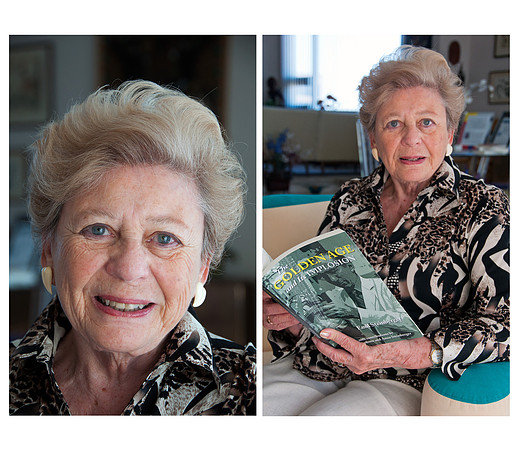
Anna Steinberger
Anna Steinberger, Ph.D.
Age 83
Anna Schneider was born to a Jewish family in 1928 in Radom, Poland. Her father was a tailor and designer of women's coats and suits, and her mother was a seamstress. She had one brother who was 5 years older.
When Germany invaded Poland on September 1, 1939, Anna was 11 years old. Three days later her uncle, a country doctor, came with a horse-drawn buggy and the family (8 persons) rode east trying to escape the advancing German occupation. They left all their possessions behind except for the clothes they were wearing. They stopped in eastern Poland where the Russian army was advancing and were sent to work on a collective farm near Stalingrad. Life was very difficult as they lacked sufficient food and clothing. Anna was initially sent back to 1st grade because she couldn't speak the language. She did learn Russian and quickly caught up with her age group. The family was then moved to Stalingrad, where they lived until the German invasion of the Soviet Union in 1941. Anna's brother was drafted into the Russian army and they lost contact with him for 5 years, until the war was over. The family was forced to move again to Alma Ata in Kazakhstan (the Ukraine), where Anna finished public school and started studying medicine. At that time, she met Emil Steinberger, who, many years later, became her husband. Emil had been born in Berlin, but his family moved to Poland when he was 3. His family also escaped east to Russia when the Germans invaded Poland, but they were sent to a Russian gulag (work camp) for 1 1/2 years.
After the war both families decided to move to the United States. Anna's mother had a sister living in New York. However, they had to live in a displaced persons (DP) camp in Germany while waiting for clearance to go to the US. Meanwhile Anna and Emil continued their medical school studies in Frankfurt. Now Anna had to learn German!
After waiting 3 1/2 years, in 1949 the family moved to New York City. Now Anna was obliged to learn her 3rd new language, English. Anna and Emil married in 1950 and resumed their studies at the University of Iowa. Anna got an MS degree and Emil got an MD. Anna later completed her Ph.D. in microbiology and virology at Wayne State University. While in Iowa City, they had two daughters, one in 1951 and one in 1953.
Anna and Emil always collaborated as a team in academic and research positions. They published extensively and established fine reputations. They trained a multitude of students and post-doctoral fellows from all over the world. For ten years, 1961 - 71, they worked at the Albert Einstein Medical Center in Philadelphia. Then they moved to Houston to join the newly-formed University of Texas Medical School.
Anna's brother had remained in Poland after the war and got an engineering degree. He moved to the US in 1961 and worked in Pennsylvania until his death in 2000.
Emil retired from medicine in 2000 and Anna in 2001. Emil then wrote 3 books based on his life experiences. Anna had to finish the last one as he was too ill to do so. He died in 2008 at age 79.
Following retirement, Anna has been engaged in various capacities at the Holocaust Museum Houston. She has chaired various committees, served on the Board of Directors and been involved in educating people about the dangers of bigotry and discrimination. In 2010 she was appointed by the governor's office to be a commissioner of the newly-formed Texas Holocaust and Genocide Commission. Besides this she is studying Spanish, and is active in various Jewish organizations. Her other activities include swimming every morning, reading, visiting with family and friends, and traveling, often to lecture around the world. Her younger daughter lives in Dallas and the older one in Houston. She has one grandson who lives in San Francisco.
Anna recounted the most traumatic experiences of her life as occurring during the war: first, being always hungry for about 6 years; second, dealing with the news that the uncle who rescued the family from Poland had committed suicide along with his wife as the Germans were entering the hospital where he worked as a physician.
Anna attributes her longevity and good health to having an optimistic attitude, plenty of exercise, and healthy eating. She says, "It's having the confidence that no matter how bad things are, with determination and hard work you can overcome adversity and make something positive out of it".